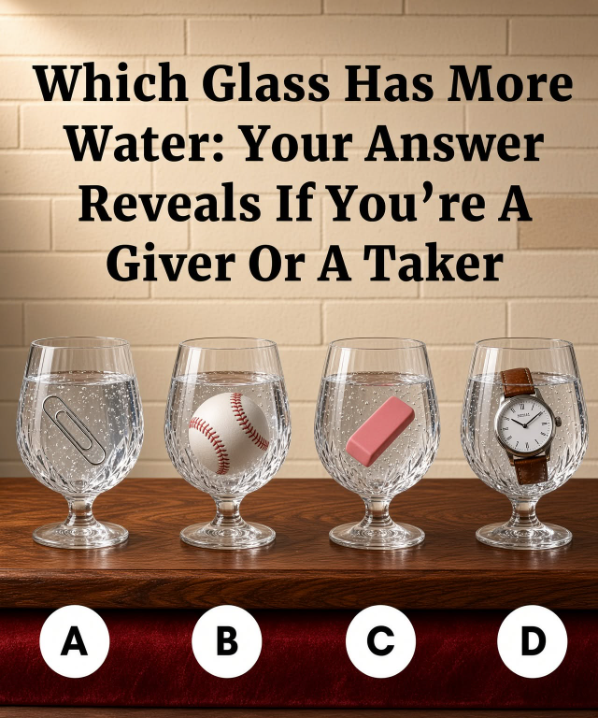
Visual riddles have a unique way of capturing public attention, sparking debates across digital communities, and challenging the way people process visual information. A fascinating puzzle has surfaced recently, presenting four identical glasses filled with water to the exact same level. Inside each glass sits a different everyday object: a paperclip, a baseball, a rubber eraser, and a wristwatch.
The question sounds deceptively simple: Which glass has the most water?
While the puzzle roots itself firmly in elementary physics, its viral appeal often hinges on an intriguing twist—the idea that your immediate answer highlights deeper traits about your cognitive style, decision-making patterns, and interpersonal tendencies. Whether you approach this puzzle with strict scientific logic or a quick intuitive guess, the way your brain processes the problem reveals a lot about how you navigate the world.
To find the true answer, one must analyze the physical characteristics of the objects submerged in each glass. Every object occupies space, thereby shifting the liquid around it.
The first glass contains a standard metal paperclip. Made of thin wire, a paperclip has a very small physical footprint. When dropped into water, it takes up minimal space.
The second glass holds a baseball. Out of all the four items displayed, the baseball is clearly the largest in terms of physical dimensions. It fills a significant portion of the glass’s internal capacity.
The third glass contains a rectangular rubber eraser. This item falls right in the middle spectrum of size—smaller than a baseball and a wristwatch, but considerably bulkier than a paperclip.
The fourth glass features a traditional wristwatch, complete with a dial and a strap. Due to its mechanical body and wrapped band, it occupies a substantial amount of space inside the container.
To solve this riddle definitively, we have to look at fluid mechanics. The underlying scientific rule at play here is Archimedes’ Principle, which explains how objects behave when submerged in a fluid.
When you place any solid object into a container filled with water, the object pushes the water out of the way to make room for itself. The volume of the water that rises or gets pushed aside is exactly equal to the volume of the submerged object.
In this specific puzzle, all four glasses show the exact same final water level. This means the total combined volume inside each glass is identical:
To find which glass contains the maximum amount of actual liquid, we can rewrite the formula:
Because the total volume is constant across all options, the glass with the most water must be the one containing the object with the least volume.
The paperclip has the smallest volume among all four items.
Because the paperclip takes up almost no space, the glass requires more actual water to reach the shared fill line.
Therefore, Glass A contains the most water.
Conversely, Glass B, which holds the large baseball, contains the least amount of water because the ball displaces a massive chunk of the liquid.
Beyond the hard science, puzzles like this are frequently used in popular cognitive discussions to explore behavioral tendencies. The way an individual reacts to the image—whether they solve it instantly using logic, make a guess based on visual weight, or focus on the emotional subtext—can map onto distinct personality frameworks.
In social psychology, individuals are often categorized by how they approach interactions: Givers focus on contributing value to others, while Takers look to maximize what they can secure from a situation. Let’s explore how different approaches to solving this riddle connect to these behavioral styles.
If you immediately selected Glass A based on logical deduction, your mind prioritizes objective truth, accuracy, and hidden details.
Cognitive Style: You do not accept things simply at face value. You look past surface impressions to find the core mechanics of a situation.
Social Dynamic: This mindset aligns closely with a balanced, supportive disposition. You understand that true value is often quiet and unassuming, much like the small paperclip that leaves room for the maximum amount of water. You tend to give your time and energy deliberately, ensuring your contributions are effective and grounded in reality.
Selecting Glass B often stems from a rapid, macro-level visual assessment. The baseball stands out immediately, drawing the eye’s focus.
Cognitive Style: You are naturally drawn to big ideas, major milestones, and prominent features. You prefer to look at the grand scheme of things rather than getting bogged down by tiny details.
Social Dynamic: You possess high ambition and a strong presence. In group settings, you aren’t afraid to take up space and lead initiatives. While this can make you highly effective at driving projects forward, you must remain mindful to ensure that your space-taking tendencies leave enough room for others to contribute their thoughts.
People who gravitate toward the eraser often seek balance, utility, and practical application.
Cognitive Style: You prefer solutions that are sensible and middle-of-the-road. Extreme options don’t appeal to you as much as steady, reliable choices.
Social Dynamic: You are highly adaptable in relationships. You know when to step up and when to step back, maintaining a healthy equilibrium between supporting others and protecting your own boundaries. You handle social friction well, working to erase misunderstandings smoothly.
Focusing on the wristwatch indicates an appreciation for complexity, order, and time management.
Cognitive Style: You respect intricate systems, organization, and precision. A watch represents structure, routine, and carefully managed resources.
Social Dynamic: You show care through reliability and punctuality. People look to you when they need a dependable plan. You manage your interactions with clear boundaries, ensuring that your commitments are always honored on schedule.
Engaging with brain teasers, visual puzzles, and logic riddles regular basis does more than pass the time. It serves as an excellent workout for your brain, promoting lifelong cognitive agility.
Sharpening Problem-Solving Skills: Tackling riddles forces the brain to look at situations from multiple angles, improving lateral thinking.
Enhancing Attention to Detail: Visual puzzles train your eyes and mind to notice subtle discrepancies that might otherwise go unseen.
Strengthening Critical Thinking: Distinguishing between an intuitive illusion and a scientifically proven fact builds stronger reasoning skills applicable to everyday choices.



0 comments:
Post a Comment