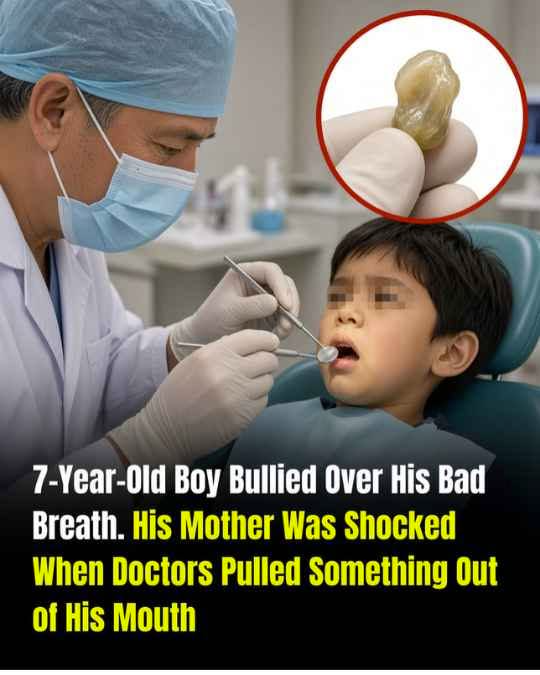
A 7-year-old boy in China became the target of bullying at school because of his persistent bad breath. His classmates avoided him, mocked him, and eventually the situation escalated into a fight, prompting his teacher to contact his parents.
Concerned about what was happening, the boy’s mother took him to the hospital for a thorough examination. What doctors discovered left her completely stunned.
After examining the child, doctors diagnosed him with tonsil stones, also known as tonsilloliths.
These small, hardened deposits form when food particles, dead cells, mucus, and bacteria become trapped inside tiny crevices in the tonsils. Over time, the material hardens into yellowish-white lumps that can produce an extremely unpleasant odor.
The condition explained why the boy’s breath had remained foul despite his daily routine.
Doctors carefully removed several of the tonsil stones using specialized medical instruments.
As the small yellowish lumps came out, the boy’s mother was surprised by both their appearance and the strong odor they produced. The stones were firm, about the size of small grains, and emitted a foul smell caused by bacteria trapped inside.
Although unpleasant, doctors reassured the family that the condition was relatively common and usually not dangerous.
Tonsil stones develop when debris becomes trapped inside the natural folds of the tonsils. Bacteria feed on this material, causing it to harden over time.
Not everyone experiences symptoms, and some people may not realize they have tonsil stones until they become larger.
Doctors advised the boy’s family to pay closer attention to his oral hygiene and daily habits.
If tonsil stones become large, painful, or keep returning, an ear, nose, and throat (ENT) specialist may recommend additional treatment.
After following the doctor’s advice and improving his oral hygiene, the boy’s condition gradually improved. His bad breath disappeared, and his classmates began interacting with him normally again.
The case serves as an important reminder that persistent bad breath is not always caused by poor brushing. Sometimes, it may be a sign of an underlying condition that should be evaluated by a healthcare professional.



0 comments:
Post a Comment